Web design for construction companies that clients trust with their projects

Someone planning a build spends months choosing a contractor and checks everything: licenses, real finished jobs, how an estimate is built, what the contract says. We build a construction company website around those checks: a project catalog, a cost estimator, photo reports from job sites, credentials and a transparent sequence of work.

Reply within 15 minutes · project assessment — free · pricing on request

A construction company office: blueprints on a desk and a laptop showing a website with a catalog of house plans, with a job site and a crane outside the window

Web design for construction companies is the work of building a site where a client sees your projects and finished jobs, runs a ballpark estimate, checks your licensing, insurance and contract terms, then requests a quote or a site visit. We build these sites for residential builders, remodelers and commercial and industrial contractors.

Why a construction company website doesn’t bring in contracts

Typical situations from contractors who come to us for a new site. The cause is almost always that the site doesn’t answer the client’s questions.

“We get inquiries, but they’re “just checking prices” and vanish”

A manager spends an hour on an estimate, sends it, and the prospect disappears. The sales team is busy and contracts are few.

We add an estimator that gives a ballpark based on area, number of floors, wall system and foundation. The inquiry arrives with the project’s parameters, and the manager calls prepared.

“The site shows renderings, but you can’t see anything we’ve actually built”

Clients know anyone can draw a picture. Without real finished jobs a company looks like a reseller of other people’s designs.

We build a finished-jobs section: location, method, timeline, photos by stage. We add the option to book a visit to a home under construction.

“Competitors rank higher in search although we build better”

The whole site is five pages, and for searches like “ICF house builder” or “timber frame home contractor” it doesn’t show up at all.

We plan the structure around demand: separate pages for building methods, home types, services and service areas. Each one is an entry point from search and ads.

“Clients are afraid the price will balloon halfway through the build”

The fear of hidden extras is the main reason a client delays the decision or goes with the contractor who showed a contract.

We publish a sample contract, what’s included in each package, the payment schedule by stage and the warranty terms. The more transparent you are, the shorter the trust conversation.

What’s included in a construction company website

The scope depends on the profile: residential building, commercial work, general contracting or remodeling each need a different structure.

Project catalog

Cards of homes with floor plans, area, number of floors, materials and specification levels. Filters by size, bedrooms, building method and budget tier: entry, standard, premium.

Estimate calculator

A ballpark by parameters: foundation, walls, roof, mechanical systems, finishes. The result goes to the client’s email and creates a deal in the CRM.

Finished and ongoing jobs

A portfolio of completed homes and jobs in progress: photo reports by stage, timeline, method. A live camera from the job site can be connected.

Building method and service pages

Wood frame, ICF, masonry, steel, concrete; foundations, roofing, mechanical systems. Each page covers pros, limits, timelines and the projects that fit.

Credentials and documents

Contractor license, insurance and bonding information, safety record, a sample contract, warranty terms and company details: everything a client checks before the first meeting.

Financing and payment

A section on financing a build with partner lenders, the staged payment schedule and a pre-qualification request form.

Client portal

For companies that want to show progress: the work schedule, photos, change orders and documents for each project in one place.

SEO foundation and markup

Organization, Product for house plans and FAQ structured data, meta tag templates and galleries and floor plans that load quickly on a phone.

Integrations for a construction business

We tie the contractor’s site to the way the company already runs sales and estimates.

CRM

HubSpot, Pipedrive or Zoho CRM, or construction-specific tools such as JobNimbus: estimator inquiries, calls and messages in one pipeline with stages from estimate to site visit to proposal to contract.

Estimating and project software

Buildertrend, Procore, Houzz Pro, QuickBooks or your estimating tool: specification packages and ballpark pricing logic synced so the calculator doesn’t drift from your real estimates.

Telephony and call tracking

Tracking numbers for ad channels and call recording where consent allows. You can see which project page produced a call.

Messaging and email

SMS, WhatsApp Business and email for sending an estimate and progress photos. A client finds it easier to receive a project link in a message.

Maps and directories

Google Business Profile, Google Maps, Yelp, Houzz and Angi: consistent office and model-home addresses, and links to your reviews.

Free project estimate and quote

Leave your contact — we'll review the task and send a quote with a scope breakdown and timelines. No pushy sales call.

Thank you! Request received — we'll get back with the estimate and quote within one business day.

How a client chooses a construction company

The sales cycle in construction is long. The site should accompany the client at every step, not just collect phone numbers.

Step 01

Studies methods and projects

Compares framing systems and looks at floor plans. Lands on a method or project page and saves the ones they like.

Step 02

Works out a budget

Uses the calculator and compares packages. Gets a ballpark and leaves contact details to refine the estimate.

Step 03

Checks the company

Looks at finished jobs, licenses, insurance, reviews and a sample contract. Books a visit to a finished home.

Step 04

Receives a quote and a contract

A meeting or an estimator’s visit to the site, a detailed quote, and agreement on the schedule and payment terms.

Step 05

Follows the build

Photo reports and documents in a client portal or a messaging thread. A satisfied client refers neighbors and friends.

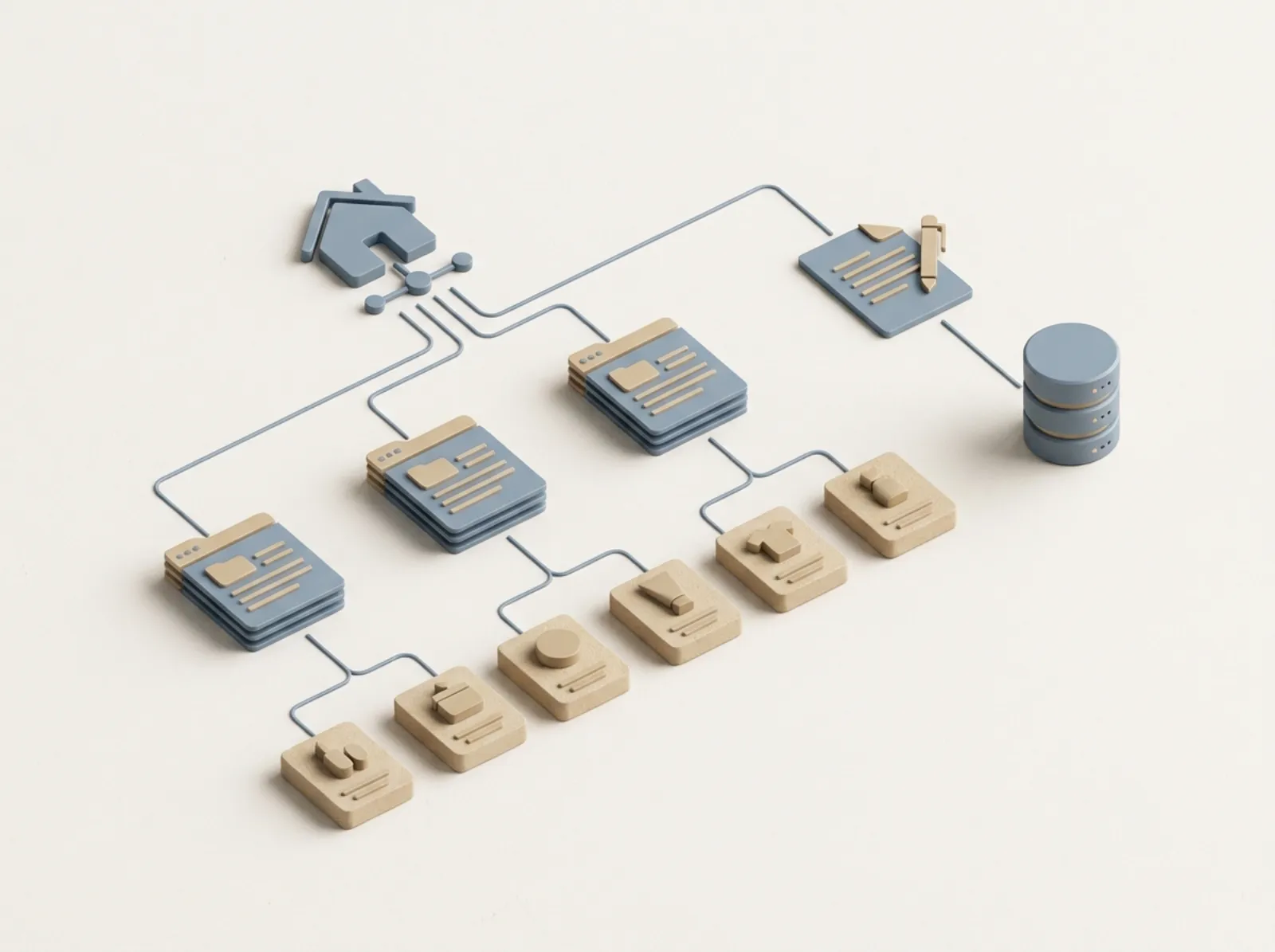
Isometric diagram of a website structure: a home page, sections and cards connected to a database
The structure of a construction company site: projects, finished jobs, an estimator and inquiries in the CRM.

A landing page or a multi-page site for a construction company

Both formats work, but for different jobs. The choice depends on where the company plans to find clients.

ParameterLanding pageMulti-page site
PurposeTest demand for one service or projectGenerate inquiries across all methods, projects and service areas
SearchGets almost no search trafficRanks for queries on methods, home types and services
AdvertisingOne landing page for every adA page of its own for each ad group
TrustA few photos and reviewsA full portfolio of finished jobs, credentials, the contract
CatalogThree to five projects on one screenA catalog with filters and project cards
GrowthA new service means a new landing pageA new service means a new page from the template

Who it’s for, and who it isn’t

A good fit if

  • You build homes, commercial or industrial projects and want clients from search and ads.
  • You have your own house plans or are ready to turn them into a catalog.
  • Your sales team spends time on “just checking prices” and you need an estimator that qualifies inquiries.
  • You need to show your credentials and finished work to win on trust.

Not a fit if

  • You work only through public-sector bids: the paperwork and the bidding portals decide those jobs, not your website.
  • You have no photos of your jobs and no project data and aren’t ready to collect them: without them a construction site doesn’t sell.

How a construction website differs from a site for other services

Construction is an expensive, long purchase with high risk for the client. A person compares several contractors, visits jobs and reads contracts. That is why a construction company’s site doesn’t work as a storefront with a Buy button but as a body of evidence: every project or method page has to answer the question “why can I trust you with my money and my land?”

The second feature is the structure of demand. People search for “ICF home builder,” “timber frame house with a porch,” “pier foundation contractor” and “custom home builder in the suburbs.” A single Services section doesn’t rank for all those queries. Separate pages for methods, projects and service areas, linked together, bring the site traffic across the whole range of queries.

The third is documents. In most places a contractor needs a license, insurance and sometimes bonding, and many states expect the license number to appear in advertising. In the UK, clients look for membership of schemes such as NHBC or Constructionline, and for commercial work, safety records. For residential clients, a sample contract with a clear scope, a stage-based payment schedule and a structural warranty matter most. We build those sections into the template from day one.

Finally, we prepare the site for promotion: a structure around methods and projects, structured data, fast galleries and data consistent with your maps listings. After launch you can add SEO and advertising without rework.


Checklist: what to prepare before we start

The more complete the materials, the faster the launch. If something is missing, we’ll help you collect it and arrange a photo shoot of your jobs.

  • A list of the building methods and services you offer and the areas you work in.
  • Your house plans: floor plans, sizes, specification packages.
  • Photos and descriptions of finished jobs, and contacts of clients willing to show their home.
  • Your contractor license number, insurance details, memberships, a sample contract and warranty terms.
  • The estimating logic or a package price list for the calculator.
  • Access to your CRM and phone system, if you have them.

FAQ: Web design for construction companies

We quote on request after a brief. It depends on the number of projects in the catalog, the complexity of the calculator, CRM and accounting integrations and the volume of copy. A foundation crew’s site and a home builder’s site with a catalog are different projects.
No, the calculator gives a ballpark for the chosen parameters. A precise estimate depends on the lot, soil conditions and specification, so the site says plainly that the final figure is confirmed after a site visit. That wording heads off disputes and warms the inquiry.
You can build to the client’s plans and present that as a service. We assemble the catalog from your finished jobs: floor plan, size, method and photos. For search, those pages work as well as stock plans.
Yes. Clients check them before they talk to you, and in many states the contractor license number is expected in advertising. For residential work the key documents are a sample contract, the warranty terms and your company details.
Yes. The structure changes for B2B: a capabilities section, equipment and staff, completed projects by type and a request-for-proposal form. The emphasis shifts from a catalog of plans to experience and resources.
It depends on the size of the catalog, the calculator and the integrations. We fix the stages and dates in the contract before we start. The project moves fastest when the materials on the checklist are collected in advance.
Yes. A structure built around methods and projects is part of the build, and after launch you can add SEO and Google Ads. A construction website without promotion rarely generates inquiries on its own.

Tell us about your task — we'll come back with a quote and timeline

In response you'll get a project estimate, a quote broken down by scope, and timelines. Usually within one business day. Free, no strings attached.

4 of 6 project slots open this week.

Request received

Thank you! We'll get back with the project estimate, the quote and the timeline — usually within one business day.

Get an estimate