AI in manufacturing that starts with a pilot on one line

On the plant floor, AI has clear places to work: defects that a tired inspector misses, downtime from sudden breakdowns, engineers who spend hours digging through work instructions. We start with one line and one metric, take the pilot all the way to production use, and only then scale it across the plant.

Reply within 15 minutes · project assessment — free · pricing on request

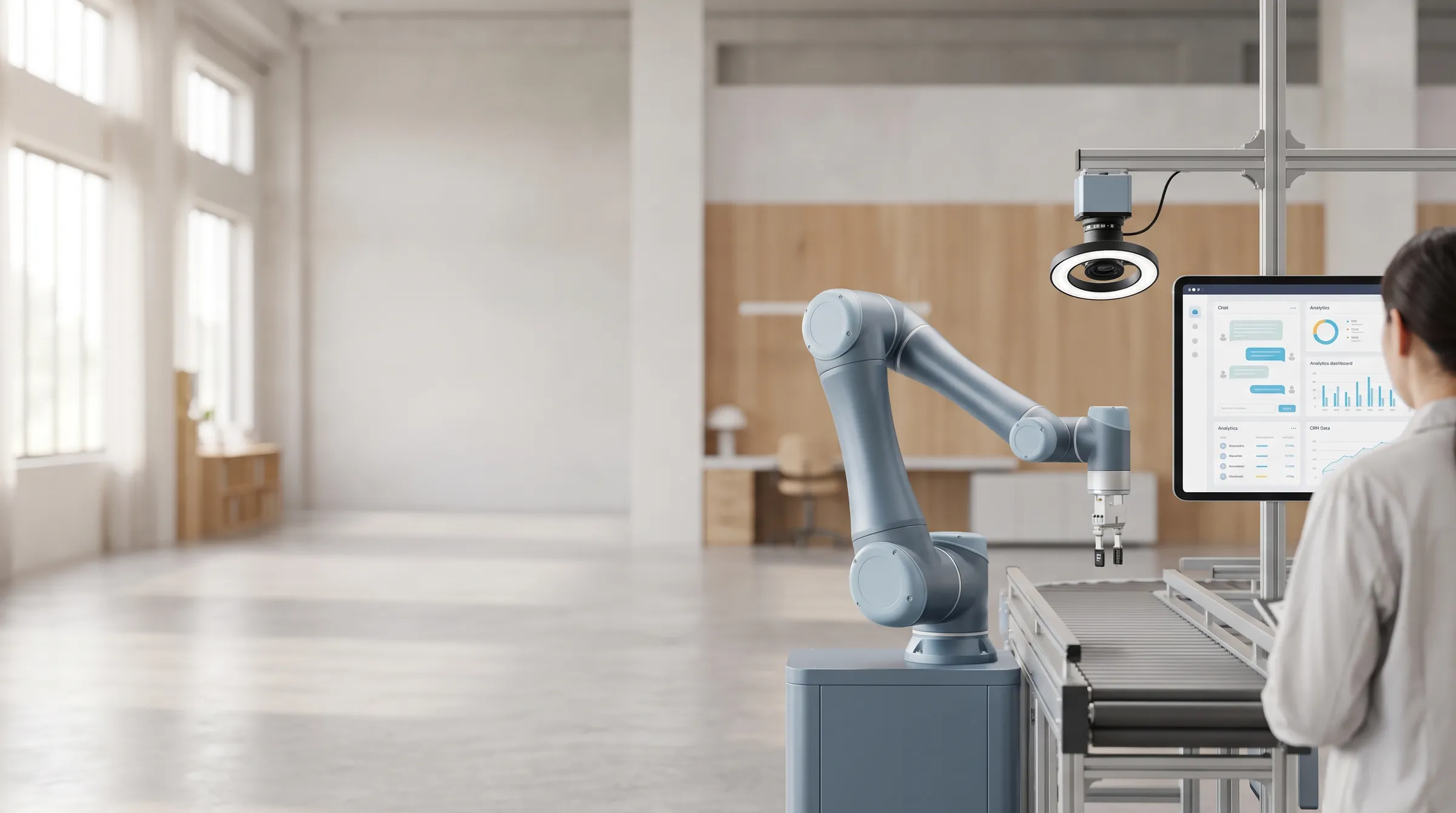
Factory floor with machine tools and a robotic arm, a quality inspection camera above the conveyor and a tablet showing AI analytics

AI in manufacturing means running machine learning and language models on real plant processes: automated visual quality inspection, predictive maintenance from sensor data, smarter production planning and an AI assistant for technical documentation. The work goes through a pilot on one line, an impact review and a handover to production use.

Plant problems that AI can take on

These are the questions that plant managers, operations directors and continuous improvement leads bring to us.

“We find defects at the customer’s dock, not on the line”

Sampling inspection lets defects through, and returns and chargebacks hurt supplier scorecards and renewals.

We put cameras and a computer vision model at the inspection station. The system checks every part and sends borderline cases to a quality inspector.

“Machines go down without warning, and maintenance hears about it last”

An unplanned line stop holds up orders and triggers rush purchases of spare parts.

We collect vibration, temperature and current data from sensors and your SCADA. A model looks for drift from normal behavior and warns the maintenance tech ahead of time.

“Answering a process engineer’s question means searching three shared drives of work instructions”

New hires spend weeks learning the documentation while senior engineers keep answering the same questions.

We connect an AI assistant to your document base: SOPs, work instructions, drawings notes and standards. Every answer comes with a reference to the exact section.

“We ran an AI pilot, and it never made it onto the floor”

Budget and time went into a slide deck while the shop keeps working the old way.

From day one we plan the route to production: integration with your MES and ERP, shift procedures and a named owner for the model.

What we put in place in manufacturing

We pick the use case based on the data you already have and the line where the impact is easiest to measure.

Visual quality inspection

Computer vision on the line: chips, cracks, weak bonds, geometry deviations, label checks and packaging completeness.

Predictive maintenance

Models trained on sensor data and repair logs that pick up early signs of bearing wear, motor overheating or blockages.

Production planning support

Load forecasting, order sequencing that accounts for changeovers, and material requirement estimates.

Process monitoring

Analysis of process parameters such as temperature, pressure and speed, with prompts to the operator when the process drifts out of its window.

AI assistant for documentation

Answers to questions about SOPs, work instructions, routing sheets and standards, with the source cited. Runs in a closed environment.

RFQ and quote handling

Reading incoming customer requests, drawings and specifications, and preparing a draft estimate for the sales team.

Workplace safety

Video analytics for hard hats, hi-vis vests, people in restricted zones and falls. The event goes straight to the shift supervisor.

Warehouse and inbound logistics

Label recognition, stock checks and a forecast of component demand from the production schedule.

Which systems AI connects to in a plant

A model is only useful when its output reaches your working systems and the right person.

ERP

SAP Business One, Oracle NetSuite, Microsoft Dynamics 365 or Odoo: orders, item master and stock for planning models, and inspection results written back to the record.

MES and SCADA

Live process parameters and equipment status, and alerts routed to the operator.

Industrial cameras and sensors

Choosing cameras, lighting and vibration sensors for the line and connecting them to a local processing server.

CMMS and maintenance software

A work order is created automatically when the model sees signs of failure in a tool such as Fiix, UpKeep or IBM Maximo.

Email, Microsoft Teams and Slack

Alerts for supervisors and maintenance, plus an AI assistant for engineers inside the tools they already use.

Free AI-readiness audit of your workflows

Leave your contact — we'll show which tasks in your business are worth automating with AI and what that means in money. No pushy sales call.

Thank you! Request received — we'll get back with the audit within one business day.

How the rollout works from pilot to production use

A sequence that lowers the risk of spending budget on something that never takes root on the floor.

Step 01

Site assessment

We visit the plant, review processes and data, and choose the line and the metric: defects caught, downtime, time spent looking for information.

Step 02

Data collection and labeling

Photos of defects, historical sensor data, maintenance logs. If data is thin, we set up collection on site.

Step 03

Pilot on one line

The model runs alongside your people. We compare its calls with the inspector’s decisions or with actual failures.

Step 04

Impact review

We measure the result against the agreed metric and decide together whether to move to production use.

Step 05

Production use

Integration with MES, ERP or CMMS, shift procedures for staff, model monitoring and retraining.

Step 06

Scaling

The proven setup is rolled out to other lines and sites.

What data you need for each use case

Data readiness decides where it makes sense to begin.

Use caseData neededIf you don’t have it yet
Quality inspectionPhotos or video of parts with defects markedWe mount a camera and build a sample on the line
Failure predictionSensor history and maintenance recordsWe install sensors and build up a history
PlanningOrders, standard times, changeovers and inventoryWe start from ERP exports and the planner’s spreadsheets
AI assistantSOPs, work instructions and routings in digital formWe digitize and structure the documents
Workplace safetyVideo from existing floor camerasWe work with your current surveillance system

Who it’s for, and who it isn’t

A good fit if

  • A plant running repeat production, where scrap or downtime is expensive.
  • You have equipment data, or you can start collecting it.
  • Management is ready to assign a line and a responsible person for the pilot.
  • You want to free engineers and process specialists from searching through documentation.

Not a fit if

  • One-off production with no repeating operations: the models have nothing to learn from.
  • You expect AI to work without your process engineers and supervisors: the solution is built with them.

Putting AI into production use: why pilots stall

The most common story in industry is a successful pilot that never reaches the floor. The cause is usually not the model but everything around it: the inspection result has nowhere to be recorded, the operator doesn’t know what to do with an alert, and nobody owns the model once the contractor leaves. That is why, during the assessment, we design how the model’s output fits into a shift, along with the model itself: who gets the signal, in which system and with what action to take.

The second barrier is data. At many plants, equipment readings are generated but not stored, and defects are logged without photos. A vision or failure-prediction model learns from history, so sometimes the first weeks of a project go to setting up collection. That is a normal stage, and it is better to plan for it from the start.

The third is security and compliance. Process data and technical documentation often cannot leave the plant network. For those cases we deploy models on your own servers or in a private cloud, and build the assistant on open language models in a closed environment. If you operate in the EU or UK, we also look at GDPR for any personal data in video and at the EU AI Act for how a use case is classified. We choose between cloud and on-premises together with your IT and security team.

Checklist: is your plant ready for AI

Go through these points before the first meeting, and the site assessment will go faster.

  • You know which line has the biggest losses: scrap, downtime, changeovers or time spent finding information.
  • A person on your side who knows the process is named as owner.
  • You have access to data: ERP exports, SCADA archive, defect photos, maintenance logs.
  • You know your security team’s requirements for storing and processing data.
  • You have agreed which metric will judge the pilot.
  • You can install cameras or sensors on the chosen line.

FAQ: AI for manufacturing

With an assessment and the choice of one line where the losses are clear and measurable. Then a pilot in which the model runs alongside your people. Scale only after the impact is confirmed on real data.
We quote on request after the site assessment. The price depends on the use case, data readiness, the equipment needed on the line and the scope of MES and ERP integration. The pilot is estimated separately from production rollout.
Yes. Computer vision models and language models can be deployed on servers inside your plant. That calls for hardware with GPUs, and we size it to the task.
You need examples of good parts and of each type of defect. The exact amount depends on how complex the part is and how varied the defects are. If defects are rare, we use anomaly detection methods that learn from examples of normal parts.
No, the job is different. The model checks every part and passes borderline cases to the inspector. The inspector’s time goes to judgment calls instead of staring at the whole flow.
Integration with working systems, shift procedures, model monitoring and a named owner at the plant. We build these into the plan from day one, not after the pilot.
We use commercial models such as ChatGPT, Claude, Gemini and Copilot where data can leave the plant, and open models on your own servers where it cannot. The stack is agreed with your IT and security teams.

Tell us about your task — we'll come back with an AI integration plan

In response you'll get an AI-readiness audit of your workflows, the priority tasks and the impact model. Usually within one business day. Free, no strings attached.

4 of 6 project slots open this week.

Request received

Thank you! We'll get back with the AI-readiness audit, the priority tasks and the impact model — usually within one business day.

Get an estimate