
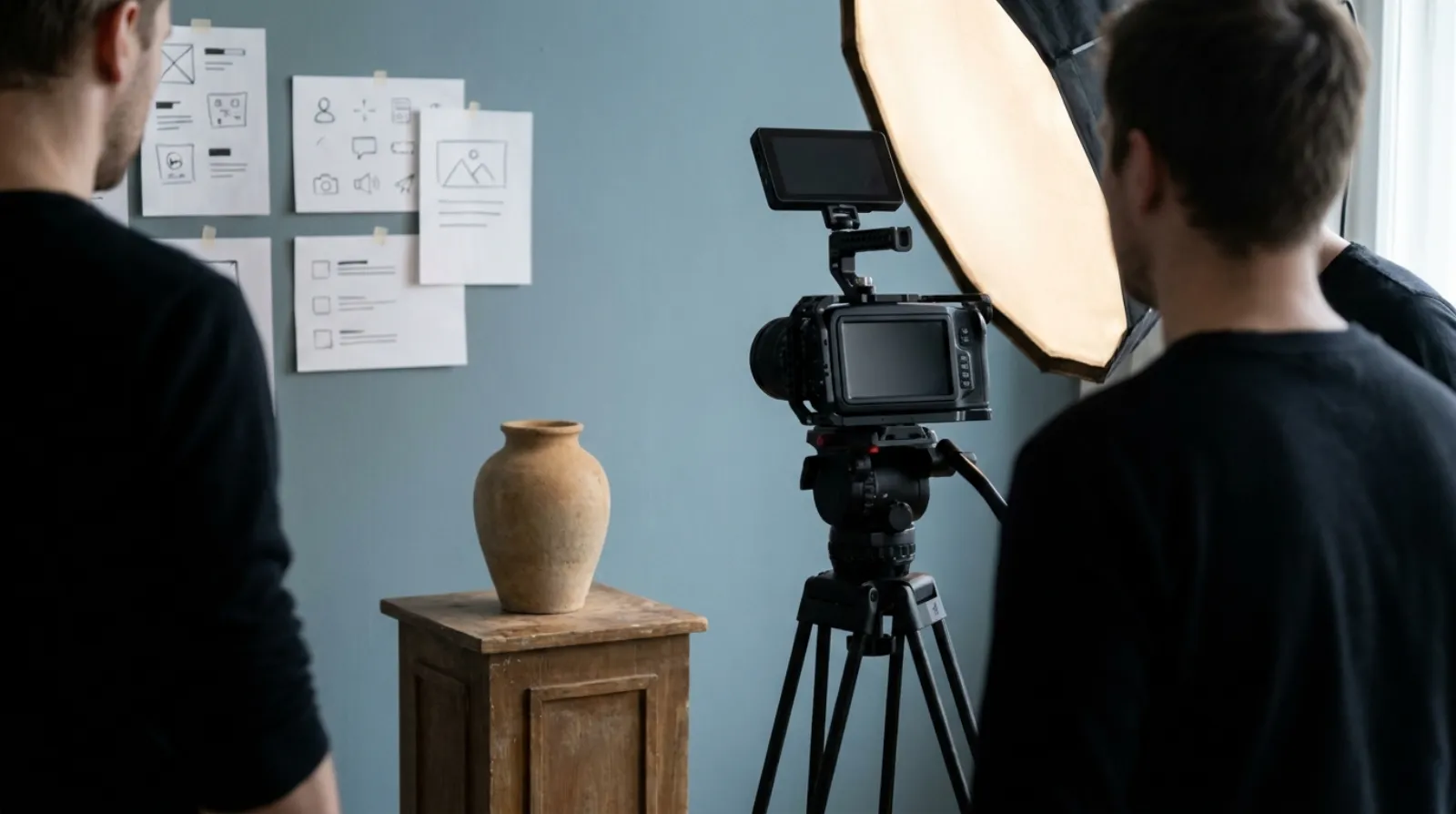
The main types of video ads are narrative live-action spots, brand films, product demos, animated videos (2D, 3D and motion graphics), explainers, testimonial and creator-style clips, and short vertical video for social feeds. Choose by goal (awareness, explanation or direct sales), by where the ad will run, and by how much time and production capacity you have.
A video ad is only as good as the decision made before the camera rolls: which format, for which platform, asking the viewer to do what. This guide walks through the formats businesses actually order, how to choose between them, and what the production process looks like from brief to final cut.
What kinds of video ads exist
A video ad is a short video made to draw attention to a brand, product or service and to move the viewer toward an action: remember the name, visit a site, buy, book a call. Ads differ on three independent axes: how they are produced, what job they do and where they run. An animated video can be a brand piece or a sales piece, and a live-action spot can run on connected TV or in a social feed.
By production method, ads are live action (camera, talent, locations), animated (built entirely on a computer) or hybrid, where footage is combined with graphics. By job, they are brand-building, explanatory or direct-response. By placement, they are made for TV and connected TV, for in-stream and out-stream placements on video platforms, for social feeds such as Instagram, Facebook, TikTok and LinkedIn, or for screens at trade shows and in stores.
Most real projects mix categories, which is why a list of formats is more useful as a menu than as a set of boxes. The sections below show what each format is for and what it demands from your team.
Types of video ads and the jobs they do
The formats businesses order most often. Many ads combine two or three of them.
| Format | What it is | When it fits |
|---|---|---|
| Narrative (scripted) spot | A story with actors, dialogue and a situation from the customer’s life | When you need emotion and recall, for a brand launch or a large campaign |
| Brand film | A portrait of the company: its people, workshop, values and way of working | For your website, trade shows, recruiting and partner conversations |
| Product demo | The item up close and in use, with its key features shown rather than listed | For online stores, Amazon and marketplace listings, and new product launches |
| 2D animation and motion graphics | Drawn characters, infographics, animated type and icons | To explain software, an app, a financial or technical product |
| 3D animation | Volumetric models of a product, an interior or a mechanism | For equipment, real estate still under construction, anything hard to film |
| Explainer | A short “problem, solution, how it works” video | For a landing page hero, sales decks and online services |
| Testimonial and creator-style video | A customer or creator describes the product in their own words | For social feeds and seeding, where trust and a natural voice matter |
| Short vertical video | A clip built for mobile feeds, with a fast opening and burned-in captions | For paid social, Reels, Shorts, TikTok and Stories placements |
How to choose a video ad type for your goal
Start with one question: what should the viewer do after watching? If the goal is to be remembered, an emotional narrative spot or brand film works. If it is to understand how a product works, animation or an explainer is the better tool. If it is a purchase today, product demos and short vertical clips with one clear offer do the job.
The second factor is placement. Connected TV and in-stream ads on video platforms are horizontal and come with strict running times. A social feed forgives simple production but demands that the point land in the first seconds and make sense with the sound off. A screen at a trade show plays without audio at all, so it needs on-screen text and strong graphics.
The third factor is what can physically be filmed. The inside of a machine, a building that does not exist yet, or a flow inside an app is easier and more honest to show with animation. The atmosphere of a restaurant or a craftsperson at work is better filmed. If you are still deciding between paid channels for the ad, our guide to paid social shows how video fits into feed advertising.
How to make a video ad: production steps
The sequence is the same for any live-action ad, from a vertical clip for social to a broadcast spot.
- Brief. The goal of the ad, the audience, the key message, the placements, the running time, mandatory elements (logo, offer, disclaimers) and the deadline.
- Concept and script. A few creative ideas, one chosen, then a script: what happens on screen, what is heard, what text appears and how long each scene lasts.
- Storyboard. A drawn or reference-built sequence of frames. Angles and composition are agreed here, before the shoot, while changes are still cheap.
- Pre-production. Casting, location scouting, props, wardrobe, the shooting schedule, and permits and releases for public locations and for anyone appearing on camera.
- Shoot. The crew works to the schedule: director, camera operator, lighting and sound. Extra takes and cutaway shots are captured for the edit.
- Edit and graphics. Assembly, color grading, titles, graphic elements and the end card with the logo and the call to action.
- Sound. Voiceover, properly licensed music, sound effects and a loudness mix that meets each platform’s technical requirements.
- Versions. Cuts of different lengths and aspect ratios: horizontal, vertical and square, plus short edits for ads and social.
How to make an animated video ad
An animated ad goes through the same stages as a live-action one, except that the shoot day is replaced by the work of illustrators and animators. It starts with a script and a voiceover text. In animation the narration matters even more, because it sets the pace and almost always carries the message.
Next comes the animatic: a rough version built from still sketches over a draft voiceover. It shows how scenes will follow each other and whether everything fits the running time. In parallel, the team picks a style: flat 2D, character animation, motion graphics with type and infographics, or 3D.
Once the style and animatic are approved, final illustrations are drawn or 3D objects are modeled, then animated. The voice talent and music are recorded and the sound is mixed. Changes during animation are far more expensive than changes at the animatic stage, so the big decisions belong before it.
- Script and voiceover text are the foundation of the whole video.
- Style frames are a few finished frames used to approve the look.
- The animatic is a draft for checking pace and story.
- Animation is the movement of characters, graphics and transitions.
- Voice and sound cover the narrator, music and sound effects.
What drives the cost of a video ad
A video ad has no single price: two videos of the same length can differ in budget many times over. The cost is calculated after a brief, once the goal, style and scope are clear. To compare quotes from production companies fairly, it helps to know what the price is made of.
For animation, the main factors are running time, style and level of detail. Character animation with facial expressions is harder than motion graphics with icons, and 3D adds modeling and rendering. For live action, the factors are the number of shoot days, locations and actors, the complexity of lighting and equipment, music rights and the usage terms for talent.
- Running time and the number of versions for different platforms.
- Animation style or the complexity of the staging.
- The number of characters, scenes and locations.
- A professional voice actor, original music or a licensed track.
- The number of revision rounds written into the contract.
- Deadline: a rush schedule needs more people working at once.
How to write a video ad script
A short ad script rests on a simple arc: a hook, the viewer’s problem or situation, the product as the solution, proof and a call to action. In a short format each part gets only seconds, so extra scenes and words are cut without regret.
The hook is the first moment, and it decides whether people keep watching. It can be an unexpected shot, a question, a situation the viewer knows, or the result shown right away. Proof is what makes the promise believable: the product in use, the production process, a real customer, a detail that cannot be faked.
Write the script in two columns: on the left what is seen on screen, on the right what is heard and what text appears. This layout shows at once whether the visuals support the narration and whether the frame is overloaded with captions. Read the text aloud with a stopwatch. If it does not fit the running time, shorten the idea instead of speeding up the narrator.
Rules and requirements for video ads
A video ad is still an advertisement, so the usual truth-in-advertising rules apply. In the United States, the FTC expects claims to be truthful and substantiated, and paid endorsements or creator partnerships must be clearly disclosed. In the UK, the ASA and CAP Code set comparable standards, and the EU applies its own consumer protection and unfair commercial practices rules. Regulated categories such as health, finance, alcohol and gambling carry extra restrictions, which vary by country.
Every platform also has its own ad policies and technical specs. Meta, YouTube, TikTok and LinkedIn each review ads against their policies, and an ad can be rejected for claims, imagery or a landing page that does not match. Check the current policies of your target platforms before the shoot, not after the edit.
Check rights separately: music, fonts, stock footage, and releases for everyone who appears on camera, including the period and territory of use. Put it in a written agreement and name the platforms and regions. Without that, a finished video may turn out unusable in the next campaign.
Common mistakes when making a video ad
For tests and short ads, teams increasingly use AI video generation. We cover where it fits in AI video for business. When a shoot is not needed or the budget is tight, part of the work can be produced with generative tools, as described on the page about AI video ads.
- No single main idea. The video tries to say everything about the company and the viewer remembers nothing.
- A slow start. A logo animation in the opening seconds gives people a reason to scroll away.
- One cut for every platform. A horizontal video cropped to vertical loses half the frame.
- No clear action at the end. The viewer finishes the video and has no idea what to do next.
- Changes after the shoot. Script changes at the edit stage are often impossible without reshooting.
Related services: Video Production, Full-service marketing, SEO Services.
More on the blog: How to set up Google Ads, AI video for business, How to start an online store.